- Boredom/Armchair Theatre (Harvest HAR 5005) 1969
- An Asylum For The Musically Insane (Harvest SHVL 761) 1969
- Jo Sago (Harvest SHVL 785) 1970
Tea & Symphony
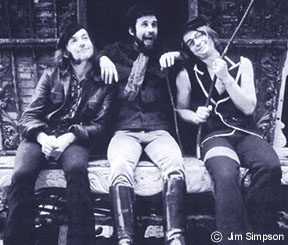
BIRMINGHAM
Last updated January 2022
Jeff Daw vocal, guitar, flute
James Langston guitar, vocal
Nigel Phillips keyboards, vocal, percussion (left 1969)
Dave Carroll guitar, bass, violin, vocals (joined 1970, left 1971)
Bob Wilson guitar, keyboards (joined 1969, left 1971)
Peter 'Chatters' Chatfield drums (joined 1970, left 1972)
Tom Bennison bass guitar, french horn (joined & left 1970)
Mick Barker drums (joined 1971)
Stewart Johnson guitars, vocal (joined 1971)
Jonathan Benyon "Cockroach" mime
Ian Prebble, Steve Hayes light show
"An asylum for the musically insane"
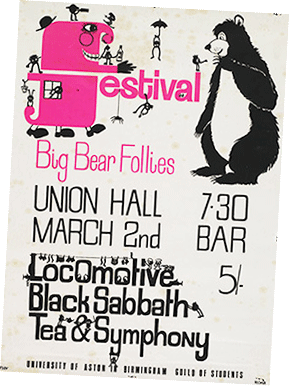
This Birmingham mixed-media group were managed by Jim Simpson whose Big Bear agency included a number of other local groups such as Locomotive and later, Black Sabbath. Jim's bands used to be known locally as "Jim Simpson's Big Bear Follies".
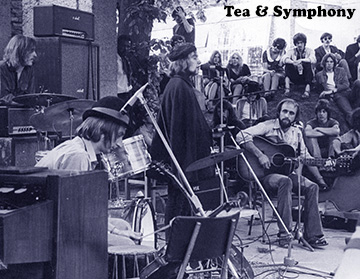
The original Tea & Symphony were an acoustic-based group similar to Marc Bolan's "Tyrannosaurus Rex". The core members were Jeff Daw, James Langston, and Nigel Phillips with the line-up supplemented by additional musicians as required.
Tea & Symphony gained a reputation early on, for their strange stage-shows and presentation which included as much theatrical as musical content. They were probably the first local group to perform at Erdington's legendary "Mothers" club hosted by influential disk jockey John Peel that opened in August of 1968.
This internationally famous venue that specialized in booking the top "progressive" groups, was previously known as the Carlton Ballroom where a number of local acts including The Moody Blues had got their start in the early 1960's.
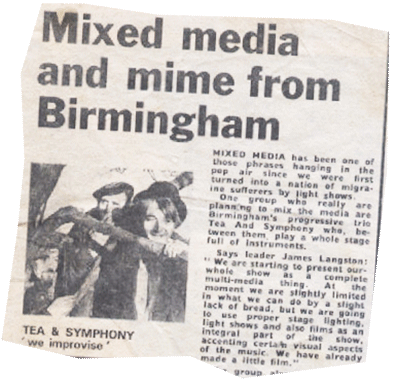
Tea & Symphony had a lightshow as part of their act. This was organized at first by Ian Prebble who left in 1970 and then Steve Hayes of Ephemera Lights from 1970 to 1971. Steve recalled; "The group was one of the very first to have an integrated lightshow, where we went so far as to actually rehearse with the band. This makes all the difference when you have the set list and know the beat, the cues, the moments to emphasize etc."
As well as using light-shows and films projected on-stage, the theatrical direction of Tea & Symphony was further emphasized by the addition of a 'mime' named Jonathan Benyon - also known as "Cockroach".
Jonathan recalled; "I roadied for T&S and later Locomotive, back in the day (1968/69). I doubled as a mime act, 'Doctor Smock' with Tea & Symphony, dancing in the light of a strobe in a surgeons gown. I have a fond memory of being mobbed in the dressing room by dozens of excited young Dutch teenagers following our daytime TV recording at Haarlem studios."
"I see Tea & Symphony developing as a mini travelling theatre"
James Langston was quoted at the time in a news feature saying; "The mime is very much related to what is going on musically. Our music has a lot of mood changes and we improvise to a certain extent." He went on to say; "I think audiences who haven't heard us before sometimes find our music very strange because of its originality. I see Tea & Symphony developing as a mini travelling theatre."
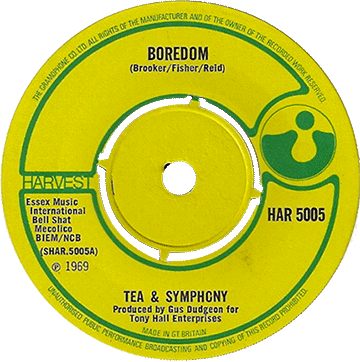
In 1969, Tea & Symphony toured with progressive blues outfit Bakerloo who were from nearby Tamworth in Staffordshire. Both groups were signed to the Harvest Records label in 1969 and Tea & Symphony were able to record under the direction of producer Gus Dudgeon who had previously worked with the famous Nottingham group "Ten Years After" and would later produce records by Elton John.
A cover of a Procol Harum song titled 'Boredom' was recorded by Tea & Symphony and issued as the A-side of a compelling single. It was certainly the most radio-friendly song they ever recorded. The group were filmed performing it for the popular German TV show "Beat Club". Strangely, this song was not included on the LP although the single's B-side 'Armchair Theatre' composed by Jeff Daw was included as an album track.
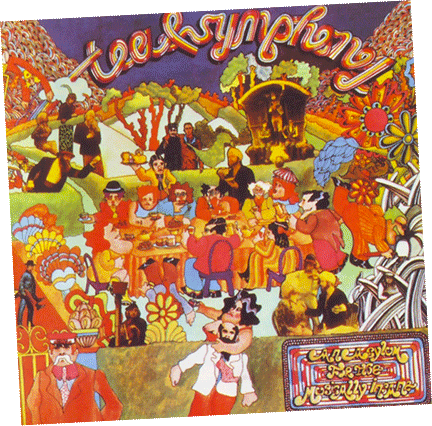
The resulting Tea & Symphony album, brilliantly and appropriately titled "An Asylum For The Musically Insane" certainly lived up to its name and was made up of nine original songs all composed by the group themselves. To describe the recordings as eccentric would be an extreme understatement - one of the songs was titled 'Maybe My Mind (With Egg)' - and reviews in the music press ranged from "brilliant" to "self-indulgent" although the latter is probably a more accurate description.
The album cast aside all commercial considerations with most of the tracks featuring weird vocal arrangements and a largely acoustic backing. Drums on the album were played by Bakerloo member Dave "Clem" Clempson with additional percussion and noises by producer Gus Dudgeon.
Most of the songs on the LP were composed by Jeff Daw and one of them 'Armchair Theatre' (a reference to the popular U.K. television series) was used as a single B-side. One of the few almost "conventional" tracks on the album was titled 'The Come On' which displayed a strong blues influence as well as some brilliant lead guitar.
After the album's release, Nigel Phillips, possibly because of a reluctance to "go electric" with a bass and drums line-up, decided to leave the group. He asked a friend Bob Wilson to take his place in Tea & Symphony as Bob was proficient in both guitar and piano. The group then went down to London to record their next album.
Session musicians Pat Donaldson (bass) and Gerry Conway (drums) were hired to play on the second album as they had a history of playing with similar kinds of bands. With the recording completed, James Langston approached Birmingham drummer Peter Chatfield at the famous musician's hang-out Bull's Head Pub on "The Green" in Moseley. Pete agreed to join the group as a full-time member and was present at the final mixing of the second album.
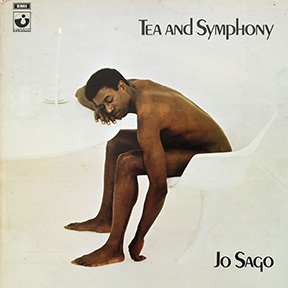
The new Tea and Symphony LP was an acoustic/electric concept album entitled "Jo Sago", recorded by Black Sabbath producer Tony Hall and Tony Cox. Issued in 1970, it followed a spoken narrative with progressive-sounding music as the story of a fictional character from the West Indies. The album was little more accessible musically than the previous release but was very engaging nonetheless.
For the live line-up, Tom Bennison from Bellbroughton Worcestershire, who played bass guitar and French horn was then recruited to the ranks of Tea & Symphony. He stayed for only a short time before he left and was replaced by Dave Carroll who played bass, electric/acoustic guitars, violin and helped out on the vocals.
"I left due to the lack of any real money coming in and the need to pay rent and eat!"
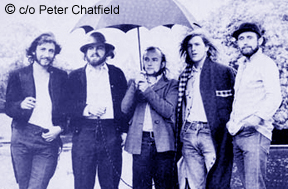
Towards the end of 1971, Bob Wilson "went on holiday" and was replaced by Stewart Johnson (guitar/vocals). Not long after, Pete Chatfield who had spent two years in the group also decided to leave. He recalls; "I left due to the lack of any real money coming in and the need to pay rent and eat!".
Pete's place was taken by Micky Barker who went on to greater things. Pete Chatfield went on to playing in all sorts of bands including Greek music for 12 years at the Ulysses Restaurant on Bristol Street as well as time with Peter Lee Stirling (Daniel Boone) and guitarist Dave Ball from Procol Harum. He also backed Coventry's Don Fardon of 'Indian Reservation' fame.
The rest of Tea & Symphony also went their separate ways. James Langston in the later 1970s, became vocalist for Brum group "Mean Street Dealers" of which Jim Simpson was also a member. Guitarists Dave Carrol and Bob Wilson went on to enjoy some success with the "Steve Gibbons Band" (formerly the Idle Race). Jeff Daw sadly passed away many years ago.
Although Tea & Symphony made little impact as far as the record charts were concerned, their two (now rare) albums continue to attract the attention of those collectors interested in the more off-beat and unconventional recordings from that era.
Special thanks to Peter Chatfield and Jonathan Benyon for assistance in preparing the Tea & Symphony biography.
Copyright © John R Woodhouse
Tea & Symphony 1960s Record Releases
Singles:
Albums:
If you would like to contribute to this page, please e-mail john@brumbeat.net