- 1) That's Alright
- 2) I'm Looking For A Woman
- 3) Sugar Babe (single version)
- 4) I've Been Watching You
- 5) I Can Go Down
- 6) Captain Man
- 7) Sugar Man
- 8) Slow Down
- 9) House Of The Rising Sun
- 10) Witness To A War
- 11) Strangers On A Train
- 12) Ivory
- 13) Back In The USSR
- 14) Out Of Time
- 15) Sugar Babe (album version)
- 16) Hold On
- 17) Roosevelt & Ira Lee
- 18) Slow Lovin' Man
- 19) Hipster
- 20) Do You Really Have A Heart?
- 21) Real Cool
- 22) Gonna Find A Cave
- 23) I'm A Rocker
- 24) Nine Live Wire
- 25) Progressive Talking Blues
- 26) Messing Around With The Blues
- 1) I Didn’t Mean To Hurt You
- 2) You’d Better Come Home
- 3) He’s In Town
- 4) Flashback
- 5) What In The World’s Come Over You
- 6) You Don’t Know What You Do
- 7) Let’s Try Again*
- 8) Ich Liebe Dich (Ecstacy)*
- 9) Brother Bill (The Last Clean Shirt)*
- 10) Without Your Love*
- 11) All Of Me*
- 12) Crazy Country Hop*
- 13) All I Want Is My Baby*
- 14) Lonely Avenue*
- 15) Shades Of Blue*
- 16) Follow Me*
- 17) Ain’t That Lovin’ You Baby*
- 18) Funny How Love Can Be*
- 19) Poor Man’s Son
- 20) You’re My Girl
- 21) If You Find Somebody To Love**
- 22) From One Who Knows**
- 23) What Can I Do**
- 24) Across The Street**
- 25) The Water Is Over My Head
- 26) Doesn’t Time Fly
- 27) Take A Giant Step***
- 28) Barterers And Their Wives***
- 29) Without The One (backing track - no vocal)***
- 30) That Lucky Old Sun***
- 1) Everything I Do Is For You*
- 2) Harvest Of Love*
- 3) The Way You Look Tonight*
- 4) I Know An Old Lady*
- 5) Happy To Blue*
- 6) Iko Iko*
- 7) When I’m Cleaning Windows*
- 8) I Need You*
- 9) The Laughing Policeman*
- 10) My Little Red Book*
- 11) I Could Make You Fall In Love
- 12) Land Of Love
- 13) Midnight Mary
- 14) Money Grows On Trees
- 15) Sometimes
- 16) Needs To Be
- 17) Smile
- 18) Breakfast At Sam’s
- 19) Dawn (Go Away)
- 20) She’s Not Like Any Girl
- 21) When I Reach The Top
- 22) Pain
- 23) Mr. Blue
- 24) Yellow Rainbow
- 25) Miss Fortune (backing track - no vocal)***
- 26) Oh Gosh***
- 27) Joe Barla***
- 28) Goodnight***
BRUM BEAT REVIEWS (continued)
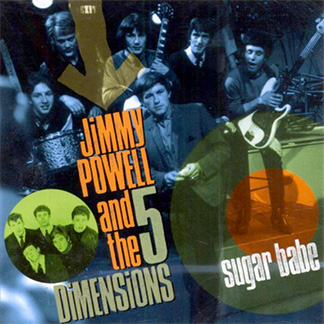
Jimmy Powell and The 5 Dimensions - Sugar Babe
Sanctuary Records Group Ltd.
(Castle Music CMRCD 640 issued in 2003)
Despite his considerable vocal talent, Birmingham singer Jimmy Powell is likely destined to be most remembered for having displaced Rod Stewart as front-man of the legendary London club group The Five Dimensions. Although such a legacy would be unfair, Sanctuary Records' anthology collection of Jimmy Powell recordings proves beyond any doubt that his voice was a force to be reckoned with and stands up to any of the great vocalists who dominated the British R&B scene of the 1960s. While not a complete collection, this is certainly the best representation to date and possibly the best we shall ever see of this rather enigmatic figure from the early British R&B scene.
Jimmy Powell falls under the category of those 1960s performers whose considerable popularity as a live attraction was never reflected in terms of record sales. The Jimmy Powell story really starts several years prior to the recordings on this CD when Jimmy, who grew up in the Birmingham U.K. suburb of West Heath and had his own band called The Detours, was invited to join local group The Rockin' Berries for bookings over in Germany. This later resulted in him being "discovered" by TV pop show producer and Decca Records scout Jack Goode who rejected the Rockin' Berries but signed up Jimmy to a recording contract. The year was 1962 and while Decca would later regret dismissing "groups" (most notably The Beatles) in favor of solo performers during this pre-Mersey Beat era, Jimmy Powell became the first of the 1960s singers from Birmingham to make it onto a record.
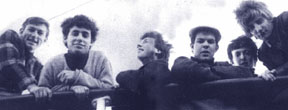
Jimmy Powell's first single release was Sugar Babe - a rousing R&B record which he would forever be associated with. Two more Decca singles followed in 1962 and 1963 which covered similar material but before any headway could be gained in chart terms, The Beatles arrived on the scene and changed everything. Jimmy's response to the "Beat Boom" was to move down to London and The Marquee Club to check out the R&B scene. It was there where his agent introduced him to a blues band called The Five Dimensions. Jimmy Powell was soon installed as lead vocalist of the group but this did not sit well with the harmonica player/vocalist of The Dimensions - a young and at that time unknown Rod Stewart. The singer was apparently frustrated with their manager's lack of confidence in his ability as front-man so Jimmy's arrival was not met with enthusiasm. Rod soon departed and the rest - as they say - is history!
This CD which was compiled and co-ordinated by Sanctuary's Roger Dopson (who also worked on the excellent Rockin' Berries anthology - see review this page), comes with an extensive fold-out of sleeve notes by David Wells. This includes a great collection of rare photos showing Jimmy in action as well as various line-ups of The Five Dimensions and associated memorabilia. The audio quality on all tracks is excellent and listening to them it's hard to believe most were recorded more than thirty years ago.
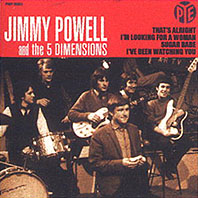
The new Jimmy Powell collection on this CD begins chronologically from 1964 with the first two singles (A and B sides) that were released after he signed to the Pye Records label. This starts with Jimmy's own self-composed rocker That's Alright which was coupled with the Bo Diddley song I'm Looking For A Woman. For collectors though, it's likely the next two tracks that will attract the most attention as both a re-make of Sugar Babe and I've Been Watching You feature the pre-Led Zeppelin Jimmy Page on session guitar along with bass guitarist John Paul Jones (Clem Cattini was on drums). This version of Sugar Babe is arguably the best and features Jimmy Powell in top screaming vocal form. Despite the promise, no chart action resulted from these releases and Jimmy soon found himself firmly entrenched in the club circuit backed by the latest line-up of the Five Dimensions.
By 1966, Jimmy Powell had signed to Miki Dallon's short-lived Strike Records label who issued the soulful I Can Go Down but while a great track, the timing was bad as by this point, the charts were dominated by pop groups. The next six tracks on the CD comprise Jimmy Powell's releases on the Young Blood label between 1969 and 1970 where he is backed by his own "Five Dimensions". Of these, Captain Man is a re-make of Jimmy's 1967 recording of the same song but with a great "live" feel. Bobby Darin's Sugar Man and Miki Dallon's own Slow Down are given a similar treatment.
House Of The Rising Sun and Witness To A War feature a more sophisticated and orchestrated production. To this listener, it's the latter track that really stands out on which Jimmy Powell shows amazing versatility with an out-of-character laid back vocal to produce a powerful anti-war anthem. Strangers On A Train and Ivory are both Jimmy Powell compositions and certainly good enough to have charted while his cover of the Beatles Back In The USSR works well as a great dance track. The compilation also includes Jimmy Powell's version of Chris Farlowe's 1966 hit Out Of Time - a song composed by the Mick Jagger and Keith Richards.
The remaining tracks on the CD are compiled from Jimmy Powell's early 1970s recording forays up to 1973 and include selections from two solo albums which have been long since deleted. Many of these tracks were composed by Jimmy himself and all showcase his distinctive vocal style although it's not indicated if any of his "Five Dimensions" are also present on the recordings. Included is a re-vamped version of Sugar Babe as well as a Randy Newman song Hold On (Have You Seen My Baby) plus Roosevelt And Ira Lee - credited to Tony Joe White. These, as well as the remaining tracks on the collection, all show Jimmy Powell in fine form which makes it seem all the more a mystery as to why he was seldom heard from after the early 1970s. Indeed, his own compositions such as Hipster, Real Cool, and the rather mocking Progressive Talking Blues, show a diversity and sophistication unlike much of his earlier work.
To sum it all up, Sanctuary's Jimmy Powell compilation is a wonderful tribute to one of the West Midland's greatest vocal talents from the 1960s as well as to the many fine musicians who recorded with him. It will be appreciated by all those who are interested in the British R&B scene from that era and indeed anyone who loves the energy generated by emotionally-charged performances against the backdrop of a gritty blues-club atmosphere.
The track listing is as follows:
For more information about this Jimmy Powell CD, visit the Sanctuary Records web site at at: www.sanctuaryrecordsgroup.co.uk
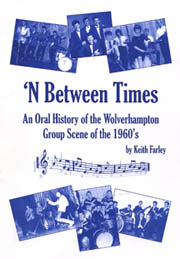
'N Between Times
An Oral History of the Wolverhampton Group Scene of the 1960's
written by Keith Farley
Published by K. Farley 2001 (ISBN 0-9541583-0-X)
This well-researched book will be of special interest to those who have lived or grew up in the Wolverhampton area during the 1960s as well as for anyone that wants to know about the groups of that era from the West Midlands. While Laurie Hornsby's book Brum Rocked! dealt mainly with the Birmingham group scene of the late 1950s and early 1960s, 'N Between Times does a great job of documenting the neighbouring "Black Country" and City of Wolverhampton.
Keith Farley has lived almost his whole life in Wolverhampton and is a teacher as well as former Head of History with a number of local secondary schools. He has written various books on local history including At The Flicks and Comrades In Arms and is also Chairman of the Wolverhampton History and Heritage Society.
In writing 'N Between Times, Keith interviewed dozens of local personalities who were once a part of Wolverhampton's and the surrounding areas thriving 1960s music scene. These interviews form the major part of the book and are reproduced and placed into context with Keith's knowledgeable narrative. Beginning with the mid 1950s local scene through to the late 1960s, the interviews come from those who were actually there at the time and not just drawn from reports of the period. The text is supplemented by an extensive selection of photos, most of which have been supplied from the different contributors' personal collections.
Some great names from the past who are documented in 'N Between Times include the late and great Tommy Burton (to whom the book is also dedicated), Danny Cannon, Dane Tempest, Steve Brett, Lady Jayne, and Raymond Froggatt as well as members of well known local groups like The Black Diamonds, The N'Betweens, Giorgio & Marco's Men, The Montanas, Finders Keepers, The Californians, Herbie's People and Trapeze amongst many others.
Most fans of Wolverhampton's world famous hit group Slade will know that The N'Betweens was the original name for the band before it was changed to Ambrose Slade in the late 1960's. Keith Farley managed to interview Jim Lea who is probably known as the least likely member of Slade to give interviews. Who could have known at the time that a group who originally started out in the "back streets of Bilston and Walsall" would eventually become one of the most successful British chart acts of all time! Members of other groups who were connected with Slade's early years also contribute material. John Taylor of the legendary Hollick & Taylor studios in Birmingham also recalls what it was like to record Steve Brett and The Mavericks whose members included future Slade star Noddy Holder.
Another great Wolverhampton group that very nearly made the "big time" was The Montanas who were popular throughout the West Midlands and even managed to have a record in the American charts but were almost unknown to the rest of Britain. Various members of The Montanas tell their own story for possibly the very first time as do members of other local groups who also made records (and there were quite a few of them) although many were only known locally. One better known example (that almost managed a record deal) is the legendary Band Of Joy whose Walsall vocalist Robert Plant and Redditch drummer John Bonham would eventually attain superstar status as members of Led Zeppelin. Keith's book includes a 1964 photo of a very young (and short haired) Robert Plant - don't ask me where he found that one!
As with Brum Rocked!, the book 'N Between Times also remembers the many different venues throughout Wolverhampton and the Black Country that hosted live music in the 1960s. Places like the Civic Hall, The Gaumont, The Cleveland Arms, Club Lafayette, and the "Woolpack" in Wolverhampton; The Ship & Rainbow (Dudley Road), The Plaza (Old Hill), "The Caves" at Wren's Nest, and the Three Men In A Boat (Walsall), to name just a few.
Totalling 112 pages in all, 'N Between Times is thoroughly recommended and certainly makes for a good read as well as an excellent and useful reference for all those who are interested in the groups from that era. It will also likely bring back a lot of great memories for anyone who was a part of or participated in Wolverhampton's local music scene in the 1960's.
For information on how to order a copy of 'N Between Times, you can e-mail Keith Farley at keithfarley1946@aol.com.
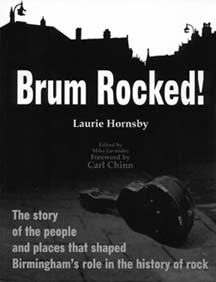
Brum Rocked!
The story of the people and places that shaped Birmingham’s role in the history of rock
written by Laurie Hornsby & edited by Mike Lavender with foreword by Carl Chinn.
Published by TGM Ltd. 1999.
At last! - a published work that deals exclusively with the influence that the early years of rock 'n' roll had on the development of the Birmingham music scene. Laurie Hornsby is a well known local historian in Birmingham and his recorded works such as The Brummagem Air and Any Road Up! are familiar to many as both fond and humorous recollections of what it meant to be a “Brummie” in working class Birmingham.
In Brum Rocked!, his first book, he has done a first-class job in telling the story of how Birmingham’s entry into the rock 'n' roll era would shape the lives of many of its citizens and eventually bring a lot of talent from the front rooms, church halls, and youth clubs, to the superstadiums of the world. Moreover, it is a story of those who pursued the rock 'n' roll dream and their adventures along the way.
The book covers an approximate 10 year period from the mid 1950’s with the first importation of rock 'n' roll from America, up until the mid 1960’s at the height of the British beat boom. Written in Laurie Hornsby’s characteristic style and humour, the book is full of recollections from those who participated in the Birmingham music scene and many who tell their own stories for the very first time.
Brum Rocked! does a great job in regards to following the tangled trails that led to the formation of some of the era’s most well known and influential groups as well as those who were unknown outside of the Midlands. Famous names like the Moody Blues and the Spencer Davis Group are just a few of those mentioned, while other local heroes such as Danny King, Keith Powell and Pat Wayne are amongst many others to be documented in detail.
Up until now, most of the groups and individuals who played a part in the making of the West Midlands music scene of that era have been virtually ignored unless they were in some way connected to a famous group, and even then, the information available about them was often incorrect or misleading. In Brum Rocked!, Laurie Hornsby finally sets the record straight by telling the stories of many Brumbeat personalities, known and unknown, who helped to create a scene that allowed so much individual and collective musical talent to flourish.
Brum Rocked! also documents the venues in and around Birmingham that provided a setting for so many of these groups. Some such as the Carlton Ballroom, the Golden Eagle Pub, and the Cedar Club which in my opinion, are of no less significance than Liverpool’s Cavern or London’s Marquee are mentioned, as well as many other local haunts that remain but distant memories today.
At over 130 pages, Brum Rocked! is packed with more than a hundred rare and previously un-published photographs, and combined with the personal recollections from dozens of Brumbeat personalities, it makes for a very interesting read which is hard to put down. Great news is that a follow-up book is reportedly in the works and you can bet that this fan will be looking forward to its release! (see review of the follow-up volume Brum Rocked On! on the previous page)
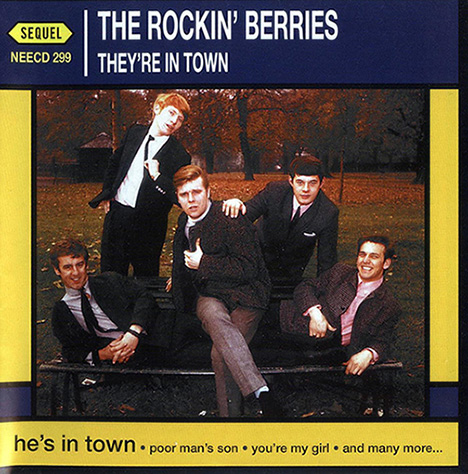
The Rockin' Berries
They’re In Town... the Pye anthology
(Sequel Records NEECD 299 issued in 1998)
This is a great collection from Sequel Records of recordings by one of the first Birmingham groups to achieve hit-single status, and at 2 CD’s and 58 tracks, it also makes for a hefty slab of Brum Beat.
The Rockin' Berries had been a part of the Birmingham music scene for quite a few years before securing a recording contract at the start of the beat boom in 1963 and although they produced many fine tracks, their recording career always seemed to take second place to their stage shows which by the late 1960’s included as much comedy and variety as music. Apart from a few exceptions, the Rockin' Berries almost exclusively recorded compositions by other artists and songwriters but nonetheless, this anthology collection contains a few surprise tracks which would have seen the group at odds with their own image if their record company had chosen to release them at the time.
The track running order is well organized and close to chronological sequence which includes all of the groups’ 1964 to 1968 singles (A and B sides), plus their two 1960s albums, a non-album extended player, plus several previously unreleased recordings. Whoever worked on the digital transfer and re-mastering of the recordings has done a great job. The sound quality of the collection is crystal clear and it makes one wonder why recent CD re-releases by higher profile bands such as the Moody Blues and the Move suffer from poor sound quality on many tracks.
The packaging is attractively designed and includes a fold-out poster inlay with photos and details of the groups’ career as well as comments from singer Geoff Turton and the Rockin’ Berries original manager John Schroeder (personally, I prefer the regular stapled booklet that comes with most CD’s rather than a fold-out format that starts to look tattered after repeated foldings).
Getting down to the recordings themselves, the first CD starts off with the Rockin’ Berries first three singles for Piccadilly Records which all showed that the group’s major strength lay in the vocal harmonies of singers Clive Lea and Geoff Turton. Although I Didn’t Mean To Hurt You was their first chart entry in October 1964, it was the group’s cover of He’s In Town that was released just weeks after that gained a No. 3 British chart position and put the group in the harmony-pop forefront.
The reported follow-up was to have been Funny How Love Can Be which was composed and recorded but as-yet unreleased by the Rockin’ Berries lablemates The Ivy League whose members John Carter and Ken Lewis were also from Birmingham. Unfortunately for the Berries, the Ivy League version was released first and made the top-ten although the Berries version did appear on their first album In Town and is an excellent rendition.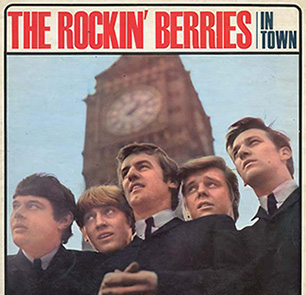
The Rockin’ Berries first album In Town contains some great tracks, although also including a mixture of comedy which makes for a somewhat uneven collection. Let's Try Again is another Carter/Lewis original, while Without Your Love and Follow Me were composed by the Rockin' Berries manager John Schroeder. Ich Lieb Dich is sung in German and was probably a throwback from the days when the group performed in German nightclubs during the early 1960’s. Another song covered on the album that has a strong Midlands connection is Shades Of Blue, as composed by Jim Capaldi and Dave Mason of the Worcestershire group The Hellions who would later join with the Spencer Davis Group’s Steve Winwood to form the legendary Traffic.
One thing that really stands out on the first album in my opinion, is Chuck Botfield’s brilliant guitar playing which is evident on songs like Lonely Avenue where he contributes a great solo. Other tracks also feature his fast playing style which seemed quite advanced and sometimes contrasting strongly with the type of material that the Berries were recording at the time.
The Rockin’ Berries cover of the Reflections’ Poor Man’s Son is a great track and worthy of its No. 5 chart position. Chuck Botfield double-tracked his guitar part for the session and the recording marked a change in direction with Clive Lea featured as lead vocalist and Geoff Turton’s falsetto distinctly absent. A bigger change for the group was the mysterious departure of bass guitarist Roy Austin shortly after the single’s release and his replacement by Bobby Thompson from Liverpool. Thompson was previously a member of Rory Storm & The Hurricanes, a group that had at one time included future Beatles drummer Ringo Starr.
The first CD ends with four previously unreleased tracks, the first of which Take A Giant Step is a brilliant Goffin & King cover and would have made an excellent single. The pastoral Barterers And Their Wives is a big departure from the group's familiar material and includes some wonderful acoustic guitar layering, while That Lucky Old Sun makes for a good sing-along.
CD 2 begins with the Rockin’ Berries second album entitled Life Is Just A Bowl Of Berries which was released in December of 1965 but did not sell as well as their previous LP. The record opens with Everything I Do Is For You which features a fine ‘fuzz’ guitar effect similar to the Spencer Davis Group’s Keep On Running that came out at around the same time.
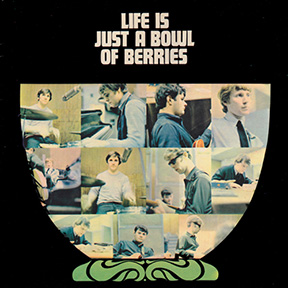
This album, as in their first, also contains a mix of comedy but displays a more polished production as is evident on songs like The Way You Look Tonight and Happy To Blue. By this time the group was displaying a preference for ballads rather than the rock 'n' roll of the earlier days and this may have been due to their increasing involvement in the club and cabaret circuit where they appeared on the same bill as non-threatening groups like The Bachelors. Harvest Of Love is a Benny Hill comedy number and shows Clive Lea’s talent for impersonations, while other tracks such as When I’m Cleaning Windows and The Laughing Policeman were probably integral parts of the Rockin’ Berries stage shows by that time. The second album ends with Burt Bacharach's Little Red Book which also gets the fuzz guitar treatment.
The track Land Of Love was composed by Geoff Turton and Bobby Thompson and represents one of the few recordings by the Rockin' Berries that was composed by the group. This and other group compositions were confined to the B-sides of singles such as Chuck Botfield's Money Grows On Trees and Turton/Thompson's She's Not Like Any Girl although the Thompson/Turton song Needs To Be would probably have made it as an A-side if not for its sparse production.
By early 1966, the Rockin’ Berries were in a downward spiral as far as the record charts were concerned and the excellent The Water Is Over My Head single in 1966 would turn out to be the group's last hit. Although the Rockin' Berries continued to release good singles, the record-buying public seemed to have lost interest, though the group was by this time much in demand as a live act on the "cabaret" circuit. The single Midnight Mary displays a lavish Phil Spector like production, while the Charlie Chaplin classic Smile, although with a simple backing, has a multi-layering of vocal harmonies and shows the group at their strongest.
Probably the most fascinating track in the collection is the song Yellow Rainbow which has Roy Wood credited as its composer. Fans of the Move will know that Yellow Rainbow was a track that appeared on the first Move album in 1968 and featured a lead vocal by bass guitarist Ace Kefford. The Yellow Rainbow as recorded by the Rockin’ Berries is an entirely different song and is totally out of character with the type of material that the group had been known for. The song’s pop/psychedelic overtones and trippy lyrics are pure Roy Wood for the period, but there also lies the mystery; how could two completely different songs from the same time period both have the same name and same composer? If anyone has more information about this track, then please let me know. Unfortunately, the Rockin’ Berries version of the song was never released at the time but is brilliant nontheless and might have provided some much needed credibility for the group as well as re-igniting their chart career.
The remainder of the second CD is filled up with previously unreleased and unfinished tracks that tantalizingly provide a glimpse of what might have been. The only real disappointment of the entire collection for me, is the non-inclusion of the group’s first two Decca singles from 1963, but apart from that it’s an excellent release and a fine tribute to a group whose chart career unfortunately ended all too soon.
The track listing is as follows:
CD 1
CD 2
* album track, ** EP track, *** previously unreleased
BACK TO BRUM BEAT HOME PAGE